
SIPTU Care Centre Workers in Shankill Strike
The local dispute reflects government policies and shows the need for radical change

16th July 2026
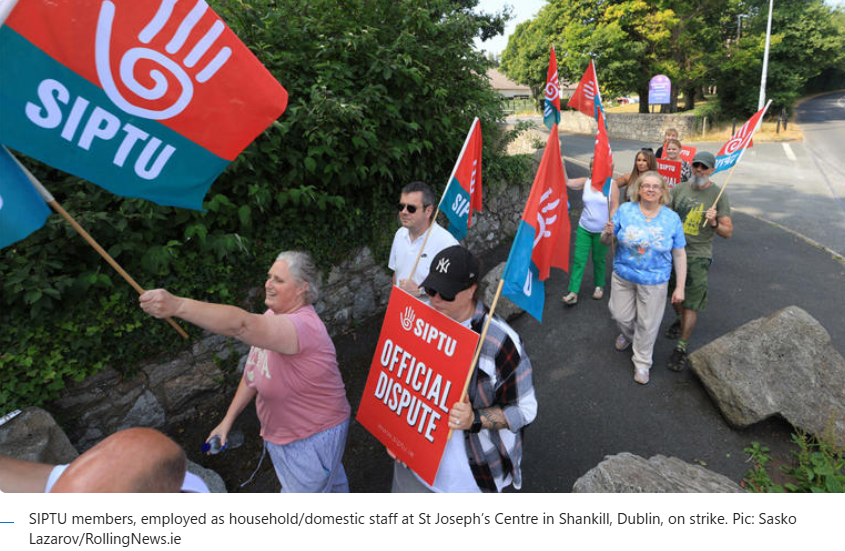
The St Joseph’s Centre in Shankill, Dublin, is the country’s largest care home dedicated solely to dementia care. Following a breakdown of talks at the Workplace Relations Commission (WRC) on Monday 13th July, SIPTU members employed as Household/Domestic Staff at St Joseph’s Centre in Shankill, Dublin, have initiated what are planned to be a series of six one-day strikes in the month of July which will go ahead unless the dispute is resolved.
The dispute follows management’s failure to appropriately pay workers in line with the duties they currently carry out. SIPTU representatives met with management at the WRC on Monday for last-minute talks in an effort to prevent the upcoming industrial and strike action.
At issue is the management’s failure to recognise the Union’s claim for enhanced pay for Household/Domestic Staff and a re-grading of their roles to Multi-Task Attendant. As with the ambulance workers earlier this year, the workers argue that while their daily responsibilities have expanded significantly over the years, their pay and formal job titles remain tethered to outdated domestic roles.
Underfunded Services at Arm’s Length
As a non-profit, mostly state-funded charity, St. Joseph’s Centre is reliant on funding from the Health Service Executive (HSE) which has failed to keep pace with the rising costs of care. The Centre is operated by lay management for the Society of John of God (SJOG), a Catholic charity which provides care for over 12,000 children, adolescents and adults with intellectual disability and mental health issues and employs 3,500 staff and 420 volunteers at 300 locations across Dublin, Kildare, Kerry, Wicklow, Meath and Louth.
In 2020 and again in 2024 SJOG issued formal notices to terminate its service arrangements with the HSE citing an "intractable funding crisis" that had prevailed for over a decade, leaving them with an accumulated deficit of tens of millions of euros (€37.7 million in 2020). Of course, the HSE has not taken over because keeping services at arm’s length allows the State to shift the political fallout of service crises away from Leinster House.
In 2025 the government significantly increased overall capital investment by 21.2%. In line with the governments's National Development Plan this money is going into roads and data centre-linked energy grids. Meanwhile, despite the 4% rise in spending in the 2026 budget, social care and healthcare services are operating on a tightrope. The tax revenue of a capitalist country is derived from the labour of workers and belongs to the public. The government acts as a corporate piggy bank with money spent on business-friendly infrastructure while the social fabric crumbles.
Big reductions in service provision while lying about ‘efficiency savings’
Despite enormous tax revenues, the government has consistently underfunded health and social services. The Irish Fiscal Advisory Council (IFAC) notes that in each year from 2023 to 2025 the budget for hospitals was set below the previous year’s actual level of spending. Because staff pay increases, health sector inflation, demographic pressures, and growing demand all tend to push spending upwards, “setting the budget below the previous year’s actual spending therefore implies sizeable efficiency savings or big reductions in the level of service provided”.
Even though, as expected, the savings fail to materialise, the government continues to push the savings lie to provide cover for its austerity policies.
The strikes promised by SIPTU workers at St. Joseph’s are an urgent and necessary part of the fight back against the government’s arm’s length neglect. The management of the Centre must re-grade the staff to reflect the work they do. But Irish state policies are at the root of the underfunding and austerity meted out to working people in the public sector. The local struggle reflects the need for revolutionary change.