
Carbon Offsets: what they are, why they don't work and how fraudsters make millions from them
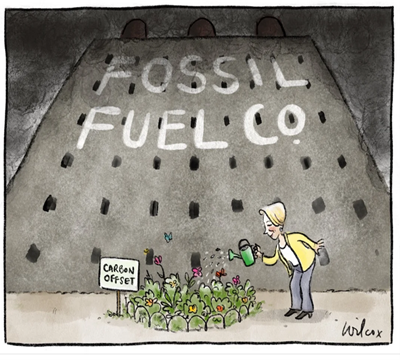
In Part One of this series, we analysed the spectacular failure of market-based attempts to lower fossil fuel extraction and use. In Part Two , we examined the underwhelming record of one of the main market mechanisms which major capitalist states have employed, i.e., carbon pricing. Below, we look at the crazy world of carbon offsets, which allow companies to pay for polluting by paying for emissions reducing oppprtunities elsewhere. At least that's the theory. In real life Carbon Offsetting enables both continued pollution and opportunities for fraud and deceit.
How Offsetting Works: in Theory, and in the Real World
In 1997, the Kyoto Protocol committed industrialized countries to binding greenhouse gas reductions based on their 1990 emissions. However, two additional market mechanisms were created that would allow capitalists in the imperialist core to purchase emission reductions from projects in Eastern Europe (Joint Implementation – JI) and the developing world (Clean Development Mechanism – CDM) rather than make reductions themselves domestically. These emission reductions became known as “carbon offsets.” Offsets offer a mechanism for firms to continue emitting pollution, while paying for the privilege of doing so by ‘offsetting’ this carbon in some way, for example by planting a forest in Africa or ensuring the preservation of wetlands that would not otherwise have been preserved.

There are two types of offset. The first are emissions removal offsets, in which a firm in the imperial centre, for instance might finance a tree plantation intended to draw carbon down from the atmosphere over its assumed lifespan. The second type are ‘avoided’ emissions, which give credits to firms based on the emissions that are said to have been prevented by stopping an activity from taking place. For example, a corporation in the UK might receive credits for preserving a forest in Brazil that would otherwise have been felled for grazing.
It is by such mechanisms, that firms in the rich world claim to be ‘carbon neutral’ or ‘net zero’. In both removal and avoidance projects the rich country behind the project must prove that additional emission reductions have resulted from the project, at least in theory.
"A Wild West of Trading, Speculating and Profitmaking"
In reality, as Adreinne Buller notes, “offsets within the voluntary carbon market are entirely unregulated, from the calculations underlying the carbon they supposedly draw down or avoid, to their implementation on the ground.” The result is what Buller calls “a Wild West of trading, speculating and profitmaking”. A recent academic paper notes that, "as a means of sustaining the Global North (GN)’s consumerist and capitalistic economies, carbon trading may be (ab)used to 'offshore' the externalities of carbon emissions and can be interpreted as giving developed countries a get out of jail free card".
Because the additionality of avoided emissions is difficult to prove, the result is “a system incredibly open to abuse” (Buller). A 2016 report prepared for the European Commission found that 85% of the projects covered had a low likelihood that emission reductions were additional and not over-estimated. Only 2% of the projects had a high likelihood of ensuring that emission reductions were additional and not over-estimated
Another research paper from 2021 which looked at 1,350 wind farms in India found that at least 52% of approved carbon offsets were allocated to projects that would have been built anyway. The writers concluded that, “in addition to wasting scarce resources, we estimate that the sale of these offsets to regulated polluters has substantially increased global carbon dioxide emission”.
OFFSETS DON'T WORK
Dozens of legal challenges over the past decade have raised arguments related to carbon credits, and many have been successful at a local level, although more radical change will be required to actually lower CO2 emissions.
According to the Guardian , in 2025 a major Australian energy company acknowledged that carbon offsets do not prevent or undo damage caused by greenhouse gas emissions and apologised to its customers for allegedly misleading marketing.
More than 400,000 Australians had signed up to Energy Australia’s “go neutral” carbon offset program that since 2016 had promised to offset emissions released due to their electricity and gas consumption.
The advocacy group Parents for Climate launched legal action in the federal court in 2023 alleging the company had engaged in misleading and deceptive conduct by claiming it was reducing emissions on behalf of its customers, including by buying international carbon offsets.
In a statement, Energy Australia said it acknowledged that carbon offsetting was “not the most effective way to assist customers to reduce their emissions” and apologised to “any customer who felt that the way it marketed its go neutral products was unclear”.
The most effective way to reduce emissions is to remove the profit motive that enables fraud and inaction, and allow the democratic state to directly intervene to take the timely, radical steps that are required.