
Drugs – A Dagger in the Heart of the Working Class

The Workers Party has serious concerns around the recent recommendations of the Oireachtas Committee that possession of all drugs for personal use be decriminalised. The purported reasoning for this approach is that it is aimed at moving Ireland towards a health-led, rather than criminal approach to drug possession.
While clearly there is a legal difference between decriminalisation and legalisation, drug culture remains a dagger in the heart of the working class. While decriminalisation may not create a legal supply chain it facilitates a social and legal regime which still exposes vulnerable people to dangerous drugs. The international experience in the Netherlands, Canada, parts of the United States of America and elsewhere demonstrates that decriminalisation does not ultimately address the problem and does not decrease drug use and fatalities continue.
The capitalist state is not neutral. It is an instrument of bourgeois class rule. Any policy enacted under capitalism must be analysed in terms of how it strengthens or weakens bourgeois power and the revolutionary capacity of the working class.
For both criminalisation of drugs and a health-led approach
The suggestion that continued criminalisation increases drug use by pushing it underground or that it diverts resources away from prevention is not sustainable. There is no contradiction between criminalisation of drugs and a health-led approach which permits working people and their families to have access to free and accessible addiction treatment, mental health support, essential community and social services and the provision of proper affordable and high-quality housing and secure employment. In fact, the bourgeois state is unable to take measures to fulfil these necessary requirements.
Non-custodial measures emphasising health, harm reduction, education and rehabilitation should be the first option for vulnerable people with addiction problems and, in particular, for those who are not likely to repeat offences. The aim should be to divert communities afflicted by the drug culture and its consequences away from the courts and into support services with the emphasis on treatment and help rather than punishment while targeting the purveyors of death, social isolation, criminality and the destruction of communities.
The Oireachtas Committee proposal also fails to address the vital question that limiting drug use can only ultimately be achieved by limiting the reasons people turn to drugs. Drug markets operate within a capitalist system that prioritises profit over human wellbeing and the damage caused by drugs is not evenly distributed. The working class bears the social costs and communities already suffering from inequality, poverty, educational under-achievement, marginalisation, homelessness, sub-standard community infrastructure and underfunded public services are more vulnerable to addiction with the consequent implications for health, social and family breakdown and community destabilisation.
The bourgeois-liberal framing of the drugs problem
Drug addiction is a complex social phenomenon. The bourgeois-liberal framing of the drugs problem fails to understand the root causes of drug abuse. It ignores alienation, poverty, trauma, insecure housing, precarious work and lack of public health and social care infrastructure. The goal should be to eliminate the social conditions that drive people toward harmful substances, not to make those substances easier to purchase.
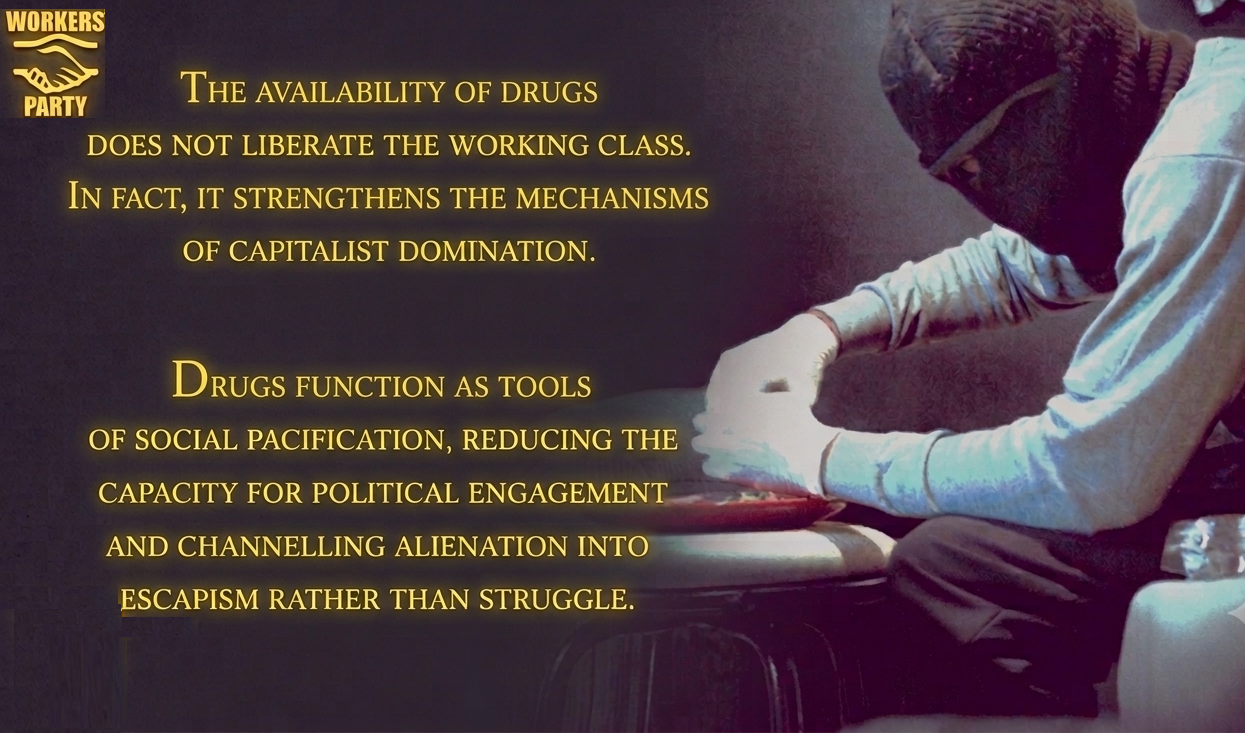
The availability of drugs does not liberate the working class. In fact, it strengthens the mechanisms of capitalist domination. Drugs function as tools of social pacification, reducing the capacity for political engagement and channelling alienation into escapism rather than struggle. The revolutionary position is not to facilitate drug use within capitalism, but to abolish the social conditions that make harmful drug use widespread in the first place.
The revolutionary struggle
The Workers Party recognises the need for a politically conscious, organised working class. Anything that weakens class consciousness or collective discipline undermines revolutionary struggle.
The availability of drugs serves to pacify and depoliticise working class communities, especially in periods of social and economic crisis. Only the overthrow of the bourgeois state and the establishment of a socialist society is capable of abolishing the conditions in which drug abuse increases and thrives.
While the Workers Party demands immediate access for people with drug related issues to addiction treatment, mental‑health support, and the provision of proper housing and secure employment as measures to tackle drug abuse, the revolutionary task is not to tolerate drug abuse but to abolish the social conditions that produce it.