
Background to the introduction of the new core RE curriculum
The publication of the draft Religious Education (RE) Core Syllabus by the Department of Education for public consultation in June 2026 came as a response to a Supreme Court ruling (JR87) that the exclusively Christian teaching of RE and collective worship in Northern Ireland schools amounted to indoctrination and breached the rights of a non-religious child and her father.
The case began in 2019 when a pupil attending a controlled (i.e., ‘non-Catholic’) primary school in Belfast was taking part in non-denominational Christian religious education and collective worship as part of the RE curriculum.
Her parents, who identify as Humanists. wrote a letter to say that their daughter’s religious education did not appear to conform with their own religious and philosophical convictions.
The school confirmed that its provision of religious education and collective worship was “Bible-based” and that it followed the core syllabus for education. The RE syllabus in Northern Ireland was first devised in 1992 and was updated in 2007 in a document written exclusively by representatives of the Catholic, Presbyterian, Methodist and Anglican churches. The resulting ‘Core Syllabus for RE’ is unapologetically faith-promoting. It opens as follows:
THE REVELATION OF GOD
Pupils should begin to develop an awareness, knowledge, understanding and appreciation of the key Christian teachings about God (Father, Son and Holy Spirit), about Jesus Christ, and about the Bible; and begin to develop an ability to interpret and relate the Bible to life. Scripture references are given as a guide to teachers and where references are given to one of the Gospels, parallel passages from other Gospels may be used.
The curriculum provides little room for students to explore other faiths, and faith is not to be taught in a critical or objective manner. As a secularist party, we do not think that any society should include faith-promoting doctrine in its schools. In addition, the 2007 church written RE curriculum doesn’t reflect the reality of the religious make-up of the pupil populations in controlled schools, including significant numbers of non-religious students.
The girl and her father brought a legal challenge and sought a judicial review against the Department of Education on the grounds that RE and collective worship in the school contravened Human Rights Law requiring the state to provide education to “respect the right of parents to ensure such education is in conformity with their own religious and philosophical convictions”.
Eventually, the case made its way to the Supreme Court (the UK’s highest court), which found that having to withdraw the pupil from religious education was “capable of placing an undue burden” on her parents and that a previous finding by the Court of Appeal was wrong to make a distinction between ‘indoctrination’ and the state conveying information or knowledge in a manner which was not “objective, critical, and pluralistic”.
In his ruling Lord Stephens said that “the concepts are two sides of the same coin: conveying knowledge in a manner that is not objective, critical, and pluralistic amounts to pursuing the aim of indoctrination.”
In addition, the judgment makes clear that the State cannot simply rely on the existence of withdrawal mechanisms to justify doctrinal religious instruction. As the lawyer for the student said, “schools must not place children in the impossible position of being singled out or stigmatised simply because their families do not share the religious worldview embedded in the curriculum.”
In June 2026 the Department of Education produced an updated draft RE core curriculum for Northern Ireland. The document was written by two educationalists but with considerable advisory input from the four churches.
Some major issues are outside the purview of the core Curriculum. For example, the Curriculum has nothing to say about collective worship in schools or with withdrawal mechanisms. Also, the Curriculum has nothing to say about the power of the Protestant churches on the school boards in controlled schools. The three main Protestant churches are represented on school boards through an umbrella groups called the ‘Transferor Representatives' Council’ (TRC), which in its Constitution encourages “the inclusion of core values within the life of schools and their community, based upon the Bible and shared Christian understanding” . The fact that TRC representatives have a guaranteed plurality on controlled school boards may make it difficult for schools to properly implement those aspects of the curriculum which are not Christian in outlook.
While the core curriculum applies both to Catholic maintained schools and state-controlled schools, the Supreme Court judgement only discusses the state-controlled sector. While the Catholic Church is keen to note this, the issues of human rights raised by the court case (JR87) will make it harder for the Catholic church to claim that it is able to teach RE according to the doctrines of that church and at the same time teach RE in an “objective, critical, and pluralistic” manner.
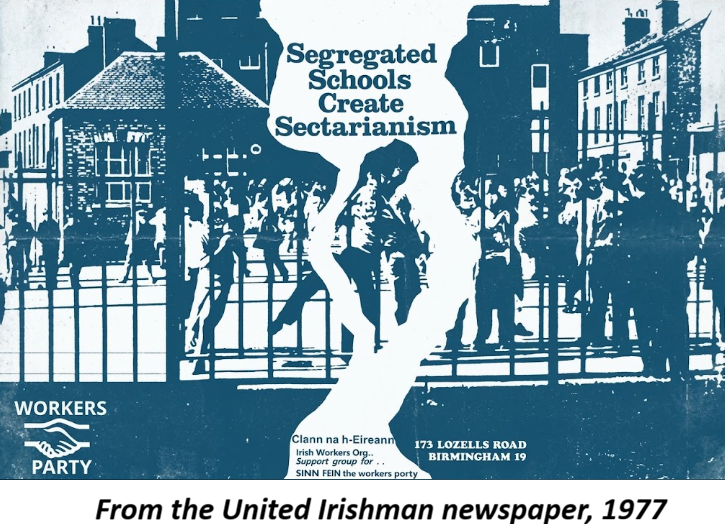
In its response to the draft document the Workers Party argues that the updated RE curriculum leaves room for schools to pay lip-service to other faith groups while mischaracterising doctrinally based teaching as “objective, critical, and pluralistic”. In addition, the court case has laid bare crucial issues related to the segregated education system in NI. If properly implemented, which it may not be, the new curriculum would be a small but important step in the right direction, but the recognition of the rights of pupils and parents which this case has endorsed have opened the door to future legal challenges.
You can read the submission by clicking on the sections below.