
Why the Workers Party is Opposed to Churches Devising the Religious Education Curriculum
by Justin O'Hagan, January 8th 2026

The Workers Party has previously commented on how the UK Supreme Court judgement of 19th November last year lays bare the failures of Northern Ireland’s segregated education system, The judgement confirmed the earlier High Court ruling which found as a matter of fact that religion is not taught in an “objective, critical, and pluralist” manner in the school in question. Crucially, the Supreme Court ruling also indicates that if religious education and worship is not “objective, critical and pluralistic”, the notional ability to opt out from RE and in-school worship will still place a school in breach of Human Rights law. Professor Russell Sanberg from Cardiff University noted that, “it is now clear that an opt-out will not be sufficient if it is capable of unduly burdening the parents”. In other words, parents don’t have to prove that an opt-out has been unduly burdensome: an opt-out would not be legal if it can possibly burden parents.
Three Types of Religious Education
In her analysis of the teaching of religion in schools in western Europe, academic Wanda Alberts outlines three main approaches, 1) education into religion, which “quite clearly describes a religious framework” 2) education about religion/s within a secular framework where knowledge about religion is communicated in a secular manner, and 3) education from religion (‘learning from religion’) which is ambiguous but “often presupposes some kind of moral superiority of religion in general or of individual religious traditions, including the idea that aspects of these traditions are advisable to be integrated into the pupils‘ own set of values”.
Ministerial Response to the Supreme Court
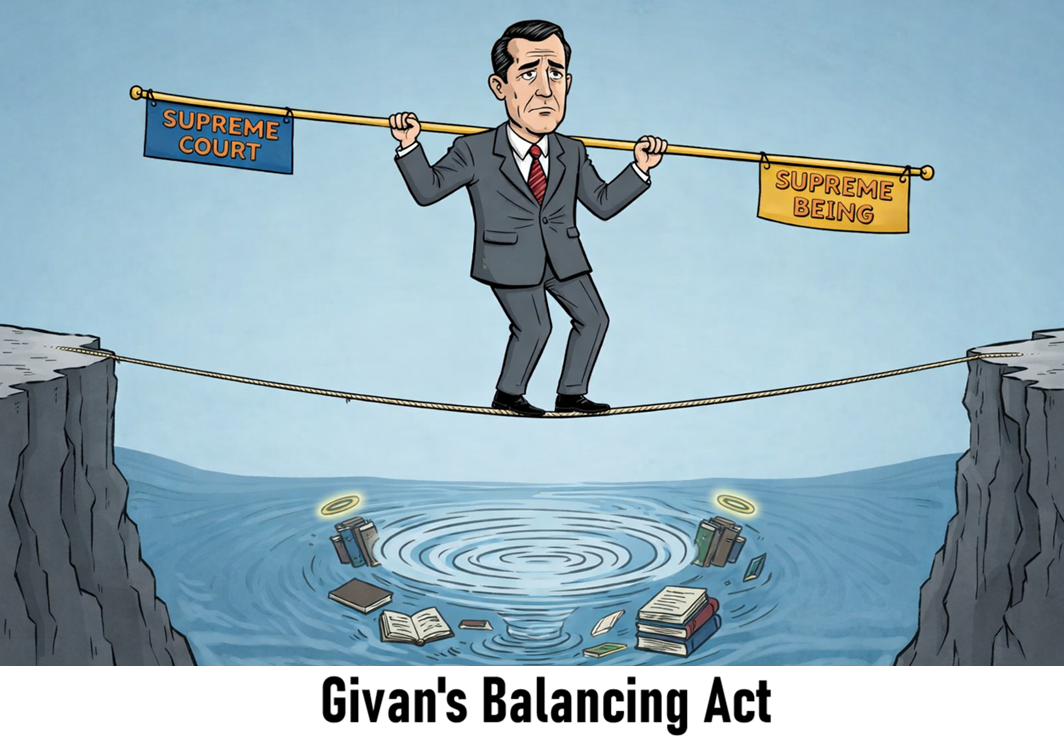
In an article published in the Newsletter a few days after the judgement, the DUP Education Minister Paul Givan stated that the religious education curriculum will be revised as part of a general review of the education curriculum. However, Givan seemed to argue that the curriculum could be revised in line with an ‘education from religion’ framework and remain legal within the terms of the Supreme Court ruling. According to Givan, “the court has acknowledged that Christianity can remain the predominant feature of any revised curriculum. … Developing RE as a strong academic subject is essential for its long-term future because academic rigour ensures credibility, relevance and respect within the wider curriculum. A robust academic framework protects RE from being marginalised or reduced to tokenistic practice”.
The question is whether a curriculum based on the presupposed moral superiority of what Givan terms ‘Holy Scripture’ can at the same time be “objective, critical and pluralistic” as per the High Court.
Collective Worship in Schools
In his Newsletter article Givan argues that the area of collective worship in schools is potentially more complex than classroom provision, stating that, “though in the case before the Supreme Court it was held that the arrangement in place at the school did not satisfy the European Convention” he will “explore whether there are arrangements for withdrawal that could be put in place that might satisfy any legal requirements”. The question remains whether in the wake of the Supreme Court ruling, any opt-out provisions would not be capable of “unduly burdening” parents.
Culture War Theatrics
We hope that Givan will be able to provide clarity on this in the near future. The Workers Party notes that Givan has framed his response to these issues in “culture war” terms identical to those of Christian Nationalists in Europe and the Americas: “there are those in Northern Ireland who are involved in fighting a cultural war. There are those who would wish to see faith driven from our schools to be replaced by every progressive cause, including trans-extremism.”
But in reality, the culture war is a rhetorical device and a distraction. Results from the most recent Northern Ireland Life and Time Survey (2024) show that 25% of respondents regard themselves as belonging to no religion. In addition, excluding those who said that they have no religion, the figures indicate that apart from special occasions such as weddings etc, 41% attend services or meetings connected with their religion between several times a week and once a month, while 18% attend several times a year and 39% attend once a year, less frequently or never. Among adherents, religious practice is varied and the figures suggest that for every true believer there is at least one half-hearted follower. These figures alone show that in Northern Ireland religious practice and faith, including the absence of faith, cannot realistically be reduced to the zero-sum game of culture war theatrics.
Secular Approach Required for Updated Curriculum
In December 2025 the ‘Religion and Worldviews Education for All’ project, which aims to explore possibilities for an inclusive approach to religious education in Northern Ireland, published a report which found that there was considerable dissatisfaction (42% overall) with the fact that churches are responsible for writing the RE syllabus. This dissatisfaction was highest among respondents of no religion (88%) while 40% of Catholic respondents and 20% of Protestants expressed dissatisfaction. The researchers also found that “roughly equal proportions of the general population were dissatisfied (38%) and satisfied (37%) that primary school children are only required to learn about Christian beliefs and practices”. The Workers Party believes that only a secular approach to public education in general and the teaching of religion in particular, can be said to provide an education free from indoctrination. This is especially the case in a society where private worship and indoctrination are freely allowed in churches, families, and non-public schools in addition to evangelism on the streets.
What is Religious Knowledge?
The Workers Party believes that religious faith is an individual matter which should not be mediated by the state either through the repression of faith groups or by the positive endorsement of a faith or faiths. In the context of Northern Ireland, people who proclaim themselves to be members of religious denominations broadly believe that their faith is the basis for supernatural and eternal ‘truths’ often unconstrained by natural or historical material limits. These ‘truths’, are often connected with what is deemed to constitute right and wrong behaviour, rules related to how to dress and how and when to worship, rules related to sexuality and sexual conduct, rules and practices regarding the status and behaviour of women, attitudes to ‘nonbelievers’ and apostates, and what is thought to happen after death. Religious tenets are often either provided to individuals via ‘revelation’ or to communities through religious texts (Bible, Koran etc.) or via organisations such as priesthoods and often by several of these methods at once. These religious tenets are often disseminated to children by adults within the family.
Religious ‘truths’
Some believers may hold that the supernatural ‘truths’ of religious faith are more important than the constraints of secular law, government, and practice. For example, it is this attitude that lies behind the charges of gross misconduct and trespassing of fundamentalist Irish Christian, Enoch Burke. Given that religious tenets are often ‘revealed’ via divine intercession and through cultural transmission via churches, families, and, in some cases, in schools, the religious tenets of one group of believers will often contradict the tenets of another group. Since the standards used to judge these differences are often not based on standards of evidence, reason, and criticality, but on tradition and revelation, and belief in supernatural agency, the public education system based on rational understanding and material limits should not be seen to endorse any of these traditions. As we have noted in our 2025 submission on integrated education, the Workers Party believes that education should be secular because it is the only way to fairly accommodate the rights of all children and parents. Outside of schools, individuals and groups are within their rights to promote faith claims and religiously oriented ethical frameworks but the state should not fund or endorse schools which exist to serve faith communities and curricula should not be based on revealed religious tenets or scriptural imperatives.
And yet, religious beliefs and practices are arguably aspects of human life worthy of critical study. As an anti-sectarian and secularist party, the Workers Party believes that members of religious denominations should play no part in devising the religious studies curricula in our public schools. Millions of school children around the world, in countries as diverse as France and China do not have any religious education as part of the school curriculum. Other countries such as Germany and Great Britain involve churches in the development of the religious education curriculum, and yet others such as Finland and Norway provide religious education curricula devised by educationalists without direct church input. The new religious education curriculum in Northern Ireland should follow the latter path.
MORE HERE