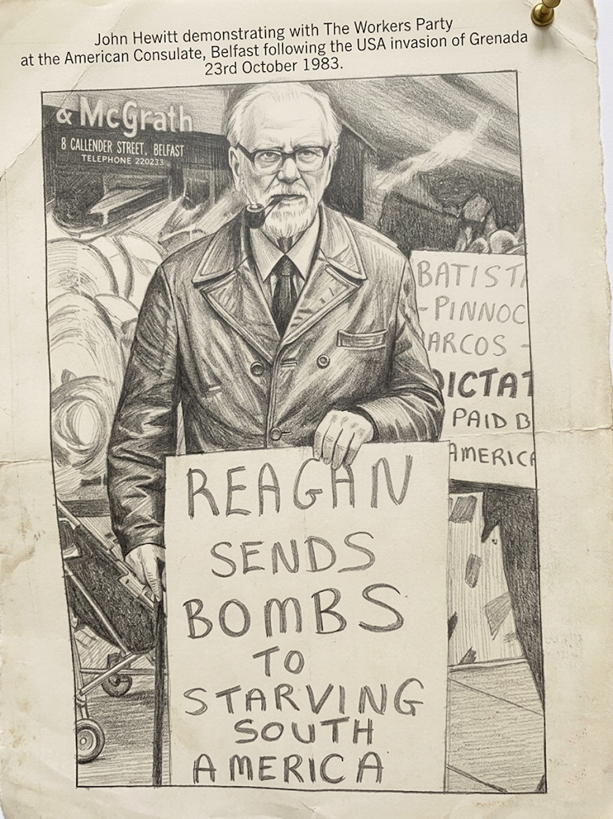
“John Hewitt, The Universal Poet” An Appreciation by Seamus Heaney
The "vigilant, democratic side of [John Hewitt's] nature was reinforced by the intellectual and moral principles of dissent which he inherited and espoused. It is true that he was something of a scientific humanist, leaving his body to be available for purposes of medical research and refusing the usual rites of a funeral service. But it also true that he had a strong sense of continuity with the Methodist traditions of his family and the non-conformist tradition of heritage of his native Ulster". Seamus Heaney
Introduction by Justin O'Hagan
John Hewitt (1907 -1987) was a poet and truth-teller. Hewitt was active in political life, describing himself as "a man of the left", and in the 1930s labour politics in Belfast. He was attracted to the Ulster dissenting tradition and was drawn to a concept and described his identity as Ulster, Irish, British and European.
As a young man in Belfast his calling to radical and socialist causes deepened; he heard James Larkin address a Labour rally, began to write for a range of Trades Union and Socialist publications, in addition to attending the Northern Ireland Labour Party Annual Conference as a Belfast City delegate in 1929 and 1930 during which he resisted the advocacy of a workers' republic in the party's constitution.
In 1930, Hewitt was appointed Art Assistant at the Belfast Museum and Art Gallery, but his radical socialist ideals proved unacceptable to the arts establishment and he was passed over for promotion in 1953. In 1957 he and his wife Roberta moved to Coventry, where he was Director of the Herbert Art Gallery & Museum until his retirement in 1972. After John’s retirement, he and Roberta returned to Northern Ireland.
In a fond tribute from 2017, the poet Damian Smyth noted that his friend Hewitt “was something other than a poet - a public figure, a man of politics and history, a strong voice coming out of a dissenting tradition, although he stressed that he had no religion. … He talked about 'ancestors of the mind' as well as of the blood - key personalities from the past who could provide sustenance in our own bleak days.
For him, these included William Drennan, James Hope, FJ Bigger, John Toland of Inishowen, Alexander Irvine, ‘the asserters, the protesters’, as he described them. But these paled beside his respect for Mary Ann McCracken - anti-slaver, philanthropist, tireless and lifelong advocate for the poor - whom he regarded as Belfast's greatest-ever citizen.” (D. Smyth, Belfast Telegraph, 25th July 2017)
Smyth notes that Hewitt “empathised with what he didn't agree with, reaching out the hand to those he opposed.” As an example, Smyth describes how “the old dissenter, Hewitt, reading his poems in the Workers' Party social club in Friendly Street in the Markets was an example of that happening before my very eyes”.
We can assume that Hewiit had been invited to read as part of the ‘Poets and Pints’ events organised by Workers Festival which the Workers Party held annually in Belfast between 1984 and 2000 (?) I think that Smyth may have misread Hewitt’s motivations and that the public radical poet had more in common with the Workers Party than Smyth believes.
Some time after John Hewitt’s death, the Belfast Workers’ Festival Committee asked the poet Seamus Heaney to provide an appreciation of Hewitt, which Heaney graciously agreed to do. Below is Heaney’s appreciation
JOHN HEWITT liked to call his study his work-room, and that simple choice of words suggests much that was typical of him as a man and a poet. A work-room, after all, could just as well be found in a carpenter’s or an electrician’s house as in a writer’s, so John’s refusal of the fancier word ‘study’ was, among other things, an extension of his socialist principles into the realm of vocabulary. It was also typical of his independence of mind and his unpretentiousness. Shy as he was, he was temperamentally inclined to question consensus and to row against the stream. Anything too sedate or self-congratulatory, even a word as innocuously upwardly mobile as ‘study’, would bring out the leveller in him.
This vigilant, democratic side of his nature was reinforced by the intellectual and moral principles of dissent which he inherited and espoused. It is true that he was something of a scientific humanist, leaving his body to be available for purposes of medical research and refusing the usual rites of a funeral service. But it also true that he had a strong sense of continuity with the Methodist traditions of his family and the non-conformist tradition of heritage of his native Ulster.
It was John Montague, in an important note on Hewitt’s work in the early Sixties, who came straight out and called him “an Ulster Protestant poet”. This was done in no spirit of accusation. On the contrary, the title saluted the historical contribution which Hewitt had made by giving the Northern Irish planters an image of their predicament based upon perspectives and attitudes more generous and historically aware than their political leaders would risk or admit to. Hewitt’s exploration of loyalties and complications springing from the English and Scottish roots did not preclude affection and immersion in the Irish dimension.
Those who espoused slogans like ‘a Protestant parliament for a Protestant people’ and ‘No surrender’ should have been grateful to him for broadening their cultural power and appeal in poems like ‘The Colony’ and ‘Once Alien Here’. In these and many others such as ‘An Irishman in Coventry’, John Hewitt gave dignity and redemptive quietude to a political condition that was badly in need of both.
His first address was to his own people in the North, those civil professionals who kept a line open to the humanitarian and literary affiliations of the British left. In the Thirties, he and his wife Roberta were active in civil rights agitation against the Special Powers Act. By then, John had found his vocation as a poet and had established his career as a ‘museum man’ with a particular interest in the curatorship of pictures. This would be his official position for the rest of his working life. He remained on the staff of the Ulster Museum until the late Fifties when he was passed over for promotion because, as he later wryly remarked, he had too many Communist and Catholic friends. So between 1958 and 1972 when he returned to Belfast and a vividly renewed poetic career, Hewitt was (in a manner of speaking) sent to Coventry, as Director of the Herbert Art Gallery in that city.
In his official capacity as curator, John left his mark upon the collection under his care, but even more historically significant was the contribution he made in his unofficial capacity as creative spirit. He was one of those people who not only worked hard himself but inspired work in others. He was a goad to the talent of a couple of generations of Belfast painters. John Luke and Colin Middleton were involved with the ‘Ulster Unit’ which he formed in the Thirties in affiliation with the British ‘Unit One’.
In a later generation, his protégées included Basil Blackshaw and TP Flanagan and from listening to their conversation over the years. I have no doubt that John Hewitt contributed to their emergence as artists by his trust in their talents, his patronage and his unremitting expectations. Indeed, in conversation with anyone who had been active or interested in cultural life in Ulster over the last 50 years, Hewitt’s name is constantly coming up, sometimes as a poet but as often as not as some kind of mentor to the imaginative life of the community.
It is however, as poet rather than as cultural commissar that John Hewitt is finally to be regarded. There is a lovely consistency in his poetic personality, from the beginnings down to the most recent work. His note involves a unique mixture of reticence and firmness, of tenderness and rigour, and apart from the epoch-making work I have already mentioned, I always find myself going back to a number of poems of the 1940s and 1950s. If you have not read much Hewitt, I would recommend you start with ‘I Turn to the Landscape’, ‘Because I Paced my Thought’, ‘The Ram’s Horn’, ‘The Little Lough’, ‘The Watchers’, ‘The Stoat’, ‘The Owl’, ‘Turf-Carrier on Aranmore’, and ‘The Sheep Skull’. In these, and in a late poem like ‘The King’s Horses’, the inwardness and relish of his imagination find their proper note and fullness. In them, he outstrips the categories we keep invoking for him, such as ‘doyen of the Ulster poets’ or ‘conscience of the Planter tradition’. He becomes, instead, the universal poet, servant of his medium, renewer of the forms, discoverer of the nugget of harmony in the language and in ourselves.
His death is a personal loss to many poets. He was the last practitioner of a generation that included Patrick Kavanagh, Louis MacNeice, Padraic Fallon and, in the common mind if not in the calendar, Austin Clarke, poets who owed authority and loyalty to an old world of surer values. It has often been noted that he was never adequately repaid by the attention of critics or anthologists during his lifetime, but now he is blessed by that grace that devolves upon all good poets at the moment of their death. It is then, when the person has been withdrawn, that the work seems stronger than ever.
The King's Horses
by John Hewitt
After fifty years, nearly,I remember.
living then in a quiet, leafy suburb.
waking in the darkness, made aware
of a continuous irregular noise,
and groping to the side window to discover
the shadow-shapes which made that muffled patter
passing across the end of our avenue,
the black trees and the streetlights shuttering
a straggle of flowing shadows, endless, of horses.
Gypsies they could have been, or tinkers maybe,
mustering to some hosting of their clans,
or horse-dealers heading their charges to the docks,
timed to miss the day's traffic and alarms:
a migration the newspapers had not foretold;
some battle’s ragged finish, dream repeated:
the last of an age retreating, withdrawing,
leaving us beggared, bereft
of the proud nodding muzzles, the nervous bodies:
gone from us the dark men with their ancient skills
of saddle and stirrup, or bridle and breeding.
It was an end, I was sure, but an end of what
I never could tell. It was never reported:
But the echoing hooves persisted. Years after,
in a London hotel in the grey dawn
a serious man concerned with certain duties,
I heard again the metal clatter of hooves staccato
and hurriedly rose to catch a glimpse of my horses,
but the pace and beat were utterly different:
I saw by the men astride these were the King’s horses
going about the King’s business, never mine.