
Housing Policy in the DDR
Contribution by Lucas Ryan, originally on website of Workers Party Youth , 26th March 2026
Introduction: is housing a policy issue?
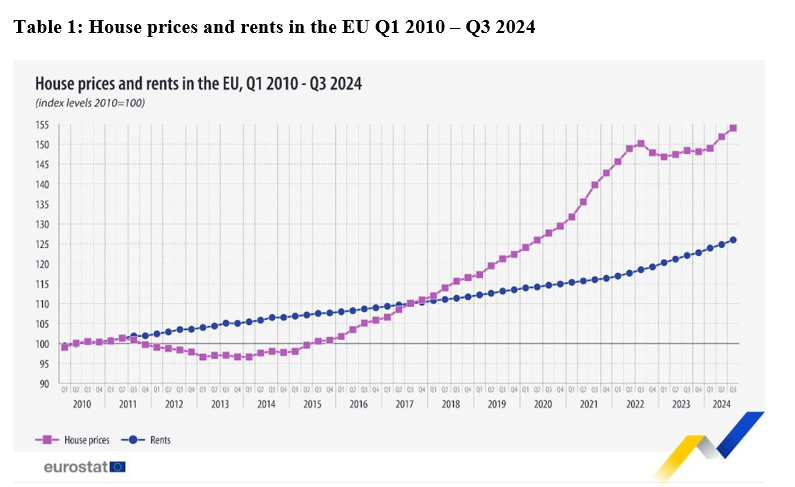
For many people in Ireland, the most important domestic issue is housing. While the housing crisis is something that is usually talked about as a failing of the Irish government in particular this is not entirely the case. The shortage of affordable housing is a European-wide phenomenon. The average increase in housing prices since 2015-2023 is 48%.1 With the increase in the Czech Republic and Lithuania being over 100% and the increase in Ireland being 69%. The reasoning for this is cited as the increased cost of construction materials and barriers to accessing mortgages. This does not include rental properties which have also increased, but at a less rapid pace.
According to Eurostat, in the period from 2019-2024 rents increased in 26 EU countries. In Ireland the increase was +109%.2 One of four other EU countries to experience increases of over 100% alongside Estonia, Lithuania and Hungary. The more powerful capitalist countries such as France and Germany have also experienced an increase in this time period, but not on the same scale. Greece was the only country in which rents decreased and Italy the only country in which housing prices decreased. This is to say that the housing crisis is not a problem with the particular policies a particular government chooses to implement.
In Spain, where the social democratic PSOE has been in power for nearly 10 years, there is no sign of the housing crisis easing. Likewise, Hungary is also gripped by the same crisis despite a government which is on the other end of the bourgeois political spectrum.
Even in the time of Engels, he wrote of a housing problem in many of the big cities of Europe. This is not a new phenomenon but does seem to have gotten significantly more acute in the era of imperialism. Engels also emphasised that this is not a problem of even contemporary capitalism but that similar situations can be found under previous modes of production. “The so-called housing shortage, which plays such a great role in the press nowadays, does not consist in the fact that the working class generally lives in bad, overcrowded and unhealthy dwellings. This shortage is not something peculiar to the present; it is not even one of the sufferings peculiar to the modern proletariat in contradistinction to all earlier oppressed classes. On the contrary, all oppressed classes in all periods suffered more or less uniformly from it.”3
For Engels the housing question was not a failure of policy but was one of the “numerous smaller secondary evils” of the capitalist mode of production. We can observe then that the housing crisis today is not new, nor is it limited to Ireland but is a phenomenon which is gripping most of the economies of Europe today. As Engels states above, the problem of housing is not even unique to capitalism but has existed under all previous forms of class dictatorships. For this reason, we can say that the solution cannot be found in this or that capitalist policy but in the change in the mode of production which produces such “secondary evils”.
Housing in East Germany
While West Germany was experiencing its so-called “economic miracle” off the back of the Marshall Plan, the situation in East Germany was much different. More than 2000 factories were dismantled and taken to the Soviet Union as war reparations. East Germany not only gained nothing from the Marshall plan but was also burdened with paying 98% of the war reparations owed to the Soviet Union while the West would pay the remaining 2%.4 Alongside this, because of the level of destruction from the war, many people’s homes were left demolished and there was an influx of thousands of refugees from further East. After 1953 many of these factories were returned and East Germany began to receive more economic support from the Soviet Union. This is all to say the starting point for the DDR was less than ideal and makes their eventual success in many areas all the more impressive.
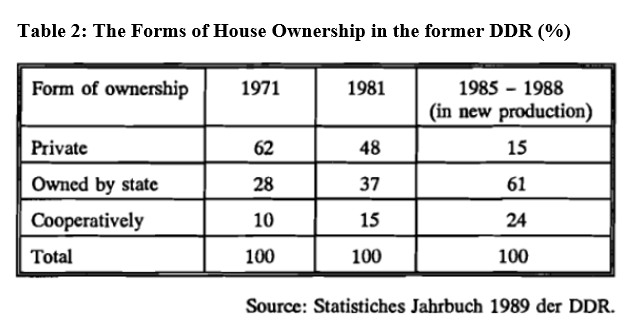
The table below shows the forms of ownership which existed in the DDR for a number of years. 1971 can be taken as the relative starting point as large scale housing projects did not commence until after the election of Erich Honecker as General Secretary in 1973.
While a significant amount of housing was either owned by workers co-operatives or directly by the state, the majority remained private. This rapidly changed in the 80s. It is important to note the above does not necessarily represent homes owned by capitalists which were rented, this may have been the case in the earlier years as few people owned their own homes. Some petit bourgeois and handicrafts men as well as some workers would have owned their own homes before the second world war, but this was not at all common and many people’s houses were damaged or destroyed in the war. As the state began to provide affordable housing on a large scale, the incentive to own one’s home decreased. This resulted in the state-owned flats being the most common form of housing in the DDR over the less than two decades.
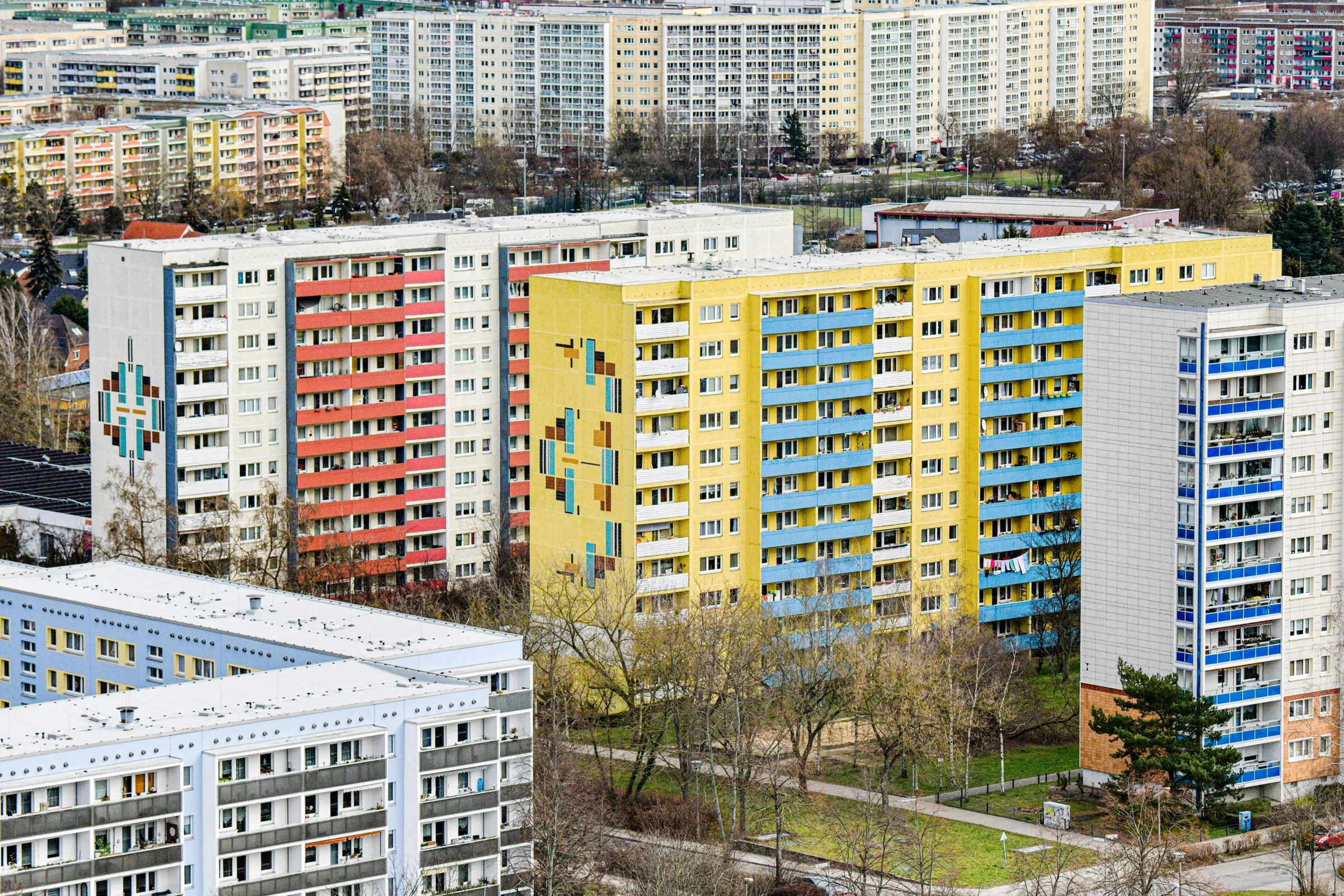
It was after the election of Erich Honecker as General Secretary that a concerted effort was made to overcome the housing crisis which East Germany inherited from the war. “Between 100,000 and 110,000 homes (mostly flats) were built each year from the mid-1970s to the mid-1980s. And the aim was to create three million new homes through renovation and new-build by 1990.”5 Prefabricated flats, which were the most common style of apartments, were relatively cheap and easy to build, with an entire complex being completed in as little as 50 days.6 These homes were equipped with everything one needed in daily life. Shops, polytechnics, creches and schools were all within walking distance from these apartments. Economic (and evictions in general) were made illegal and rent was 5% of the average annual salary, which in many cases was never a burden as most people had access to secure employment through the state.7
A study conducted by the RTB concluded that around half of Irish renters spend 30% or more on rent while 12% spend more than 50%.8 This contrast makes the achievements of socialism in the DDR clear.
This is not to mention all the other ills of capitalism which contribute to the inability for people to meet this high cost. Even “The Berliner”, which published an unreservedly anti-communist article on the “Plattenbau” admits to the following: “compared to today’s housing market, the DDR might even sound like a utopia – a world where, instead of paying €600 a month for a tiny room, you got affordable housing from the government. In the country’s 39-year existence, there was no homelessness and no evictions. “9
Conclusion
Flats in the DDR weren’t just a place to live but were also microcosms of socialist society. Each flat had a residents associations which varied a lot in their activities, as decided by their members. Some organised parties and cultural trips using the funds that were allocated to them. Other associations simply split the money among all the residents and used it as a bonus at the end of the year.10 The activity of the residents associations differed from flat to flat with some being more active than others. Some used the money to renovate rooms in the complex to be used as hobby or DIY rooms, some were used for functions and children’s parties. Despite the varying level of activity from one association to another, they all held in common a democratic structure in which all residents who wished to be involved in the life of flats were included.
While immediate measures in the course of the class struggle are necessary in protecting people against the attacks of capital, they cannot provide a solution to the inherent tendency of capitalism to seek profit wherever it can find it. Engels’ analysis of the housing crisis as one of the numerous “secondary evils” of capitalist society here is vital to understand. There can be no real or lasting change while the means of production remain in the hands of capitalists. These issues which now are perceived by many workers as the most important issue cannot be separated from the mode of production which has given rise to them or made these issues more prominent. The former socialist states act as an example of the power of the centrally planned economy in the hands of workers and the necessity of the revolutionary path. While many capitalist countries uphold the UN resolution on the right to housing, very few have achieved what the DDR and other socialist states were able to in ensuring the security of tenure and living standards of the working class.
Sources
1. https://www.europarl.europa.eu/topics/en/article/20241014STO24542/rising-housing-costs-in-the-eu-the-facts-infographics
2. https://ec.europa.eu/eurostat/web/products-eurostat-news/w/ddn-20250110-1
3. Engels, Friedrich. 1872. The Housing Question.
4. De La Motte, Bruni, and John Green. 2015. Stasi State or Socialist Paradise? : The German Democratic Republic and What Became of It. London: Artery Publications.
5. Ibid
6. https://www.the-berliner.com/berlin/plattenbau-architecture-social-housing-ddr-german-history/
7. De La Motte, Bruni, and John Green. 2015. Stasi State or Socialist Paradise? : The German Democratic Republic and What Became of It. London: Artery Publications.
8. https://www.breakingnews.ie/ireland/half-of-irish-tenants-spending-30-of-pay-on-rent-according-to-study-1157260.html?
9. https://www.the-berliner.com/berlin/plattenbau-architecture-social-housing-ddr-german-history/
10. De La Motte, Bruni, and John Green. 2015. Stasi State or Socialist Paradise? : The German Democratic Republic and What Became of It. London: Artery Publications.