
FF/FG Government launches ‘Delivering Homes, Building Communities 2025–2030’
John O'Rourke finds much to criticise in the latest government housing strategy and argues for a straightforward ongoing state-delivered public housing progamme

December 1st 2025
On 17th November 2025, the government in the Republic of Ireland, in what it claims is an attempt to solve Ireland’s chronic housing shortage, launched a new house building program. entitled Delivering Homes, Building Communities 2025–2030: an action plan on housing supply and targeting homelessness (DHBC). The FF/FG government has set a goal of building or developing 300,000 homes by the end of 2030. The government claims that since the Housing for All (HfA) initiative was launched in 2021, 137,000 homes have been built, a significant portion of which have been allocated for social housing. In answer to a 2025 parliamentary question the Minister for Housing stated that under HfA, the aim is to deliver 47,600 new-build social homes over the plan period, i.e., until 2030. Figures show that over the two years 2023-24 66% of planned social housing projects were completed.
Long Term Crises
In contrast to the DHBC’s optimistic targets, according to the government’s own Department of Finance, the housing crisis in the Republic of Ireland will continue for at least 15 years, with demand not expected to peak until the early 2030s. The housing shortage analysis is based on the report Future Forty: A Fiscal and Economic Outlook to 2065, which also contains sobering predictions on living standards into the 2030s and beyond. The report concluded that current and projected housing demand—driven by demographic trends, a growing preference for living in smaller households, and accumulated unmet need—means the current housing crisis will continue for many years.
To accomplish the ambitious housing building program outlined in Delivering Homes, Building Communities 2025–2030, the report states that the number of workers in residential construction would need to grow considerably—by nearly 50,000.
The report also highlights the cost to the average household as a result of the housing crisis. From 2015 to 2024, average house prices rose by 91% and market rents by 78%, while inflation increased by only 22%. The report bluntly states that "high housing costs pose significant challenges to the Irish economy, as they have increased the relative cost of living and are potentially impacting the country’s capacity to attract and retain a highly skilled workforce."
Vague Targets and Uncosted Promises
The key objectives of the house-building program are to construct 300,000 homes by 2030, of which 72,000 will be ‘social homes’ and 90,000 ‘affordable homes’, although the documents do not define what these terms might mean. The government seeks to deliver these homes through two main pillars: encouraging the market through regulatory reforms and tax incentives, and with vague and uncosted promises related to ‘promot[ing] homeownership, protect[ing] renters and mak[ing] buying and renting homes more affordable’. How the government expects to achieve any of this is not mentioned.
For example, in October 2024 the Department of Finance produced a report, Providing stability and certainty for investment in property in Ireland, which shows that 50 “large residential landlords” own more than 40,000 rental units built or under construction in Ireland, and that these landlords, often investment funds, own 46% of apartments built between 2017 and 2023, while private households own just 13%. According to the evidence, the rental sector in Ireland is becoming increasingly bound up with international and local financial capital and there is a vanishingly small chance that the current government will take on financialised capital in defence of renters. Nor can we expect anything from a ‘left’ government led by Sinn Féin. After all, as children’s campaigner, Michaela Rafferty notes: “neoliberal at heart, opportunistic in methods, self-interested in power, Sinn Féin, if it were to form a government in the Republic of Ireland, would be no more likely to deliver on progressive promises made to the 26 counties of the South than it has in 22 years in the six counties of the North.”
The investment needed to finance the DHBC plan is estimated at €20 billion per year. The government will provide €9 billion from three departments: the Exchequer, the Land Development Agency (LDA), and the Housing Finance Agency. The LDA will receive an additional €2.5 billion to help deliver 14,000 homes by 2029. Social Justice Ireland notes that the government’s strategy lacks the detail required to meet its own targets. For example, while there is a commitment to building an average of 12,000 ‘social homes’ per year, there is no clear annual delivery plan. Instead, the government outlines a broad target of 15,000 so-called "Starter Homes" annually—largely a rebranding of existing schemes such as the First Home Scheme, Help to Buy, the Vacant Property Refurbishment Grant, and cost-rental housing. There is no transparency regarding how many homes each mechanism will deliver, weakening accountability and making it difficult to assess likely outcomes.
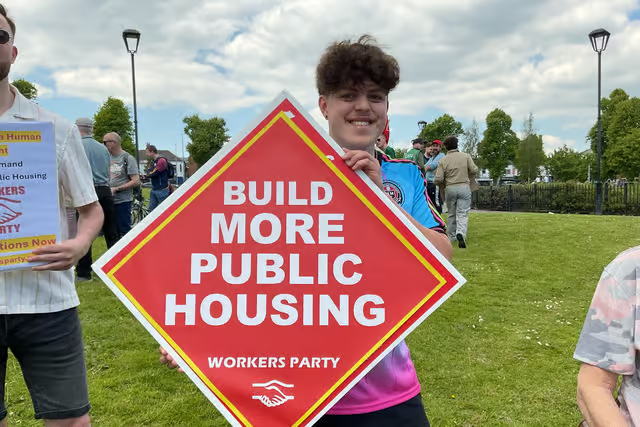
Evidence also shows that schemes like Help to Buy and the First Home Scheme do not actually improve affordability. Rather than reducing prices, they inflate purchasing power and push prices higher in a supply-constrained market. They also disproportionately benefit higher-income households purchasing more expensive homes. Instead of tackling structural causes of high housing costs, these measures effectively subsidise demand and sustain high prices.
Recent findings also underscore the societal necessity of delivering sufficient housing. A report by the National Women’s Council (NWC) warns that a shortage of housing is contributing to "crisis levels of violence against women," creating an inextricable link between homelessness and domestic, sexual, and gender-based violence (DSGBV). It calls on authorities to recognise and act on this connection.
Additionally, Focus Ireland revealed that a record 5,250 children will be homeless this Christmas. CEO Pat Dennigan emphasised that homelessness is not inevitable but the result of policy choices—and entirely preventable. The Workers Party differs in that we believe that poverty is a systematic feature of capitalist economies and not a policy choice. Although welfare policies can mitigate the worst poverty for a period of time, poverty will only be preventable, fully and forever, under a more rational system.
The Politics of Housing
Recent research suggests that Ireland’s housing pressures are also shaped by broader political/economic dynamics. Some scholars argue that the inflationary effect on domestic housing produced by the migration of high-tech workers into Dublin, may render Ireland’s growth model electorally unsustainable. Others argue that as long as a large share of Irish voters are homeowners benefiting from rising property values, political support for the current development model and conservative political parties remains secure. This stability depends on the homeowner electorate remaining larger, or at least more politically engaged, than those excluded from ownership.
Against this attempt to ‘contain’ elements of the working class within the current housing market system to the exclusion of others, the Workers Party is committed to the planned construction of housing within a democratic socialist state. This entails the growth of a class-conscious unified working class that will not be fooled by the false promises either of the current government or the social democratic ‘left’ in the Dáil.